What the River Remembers
Four movements. Four characters. One river.
Hear all four before deciding what your audience needs.
Perusal scores are available - fill out the request form below.
A New Cross Cultural Work for Orchestra and the Temporal Taal Collective
There are moments that stay with us long after words fail.
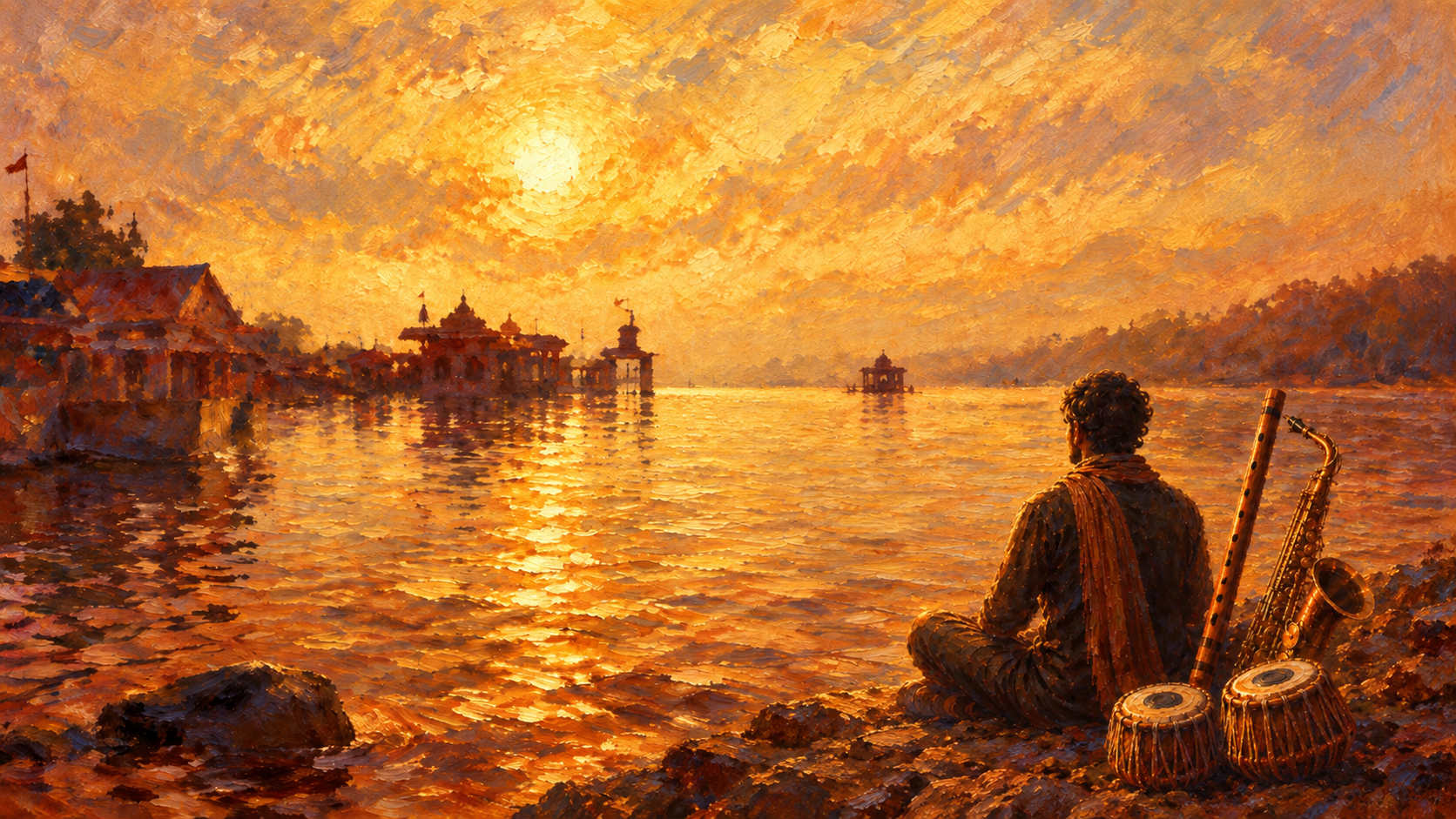
In 2024, composer and saxophonist Anjan Shah traveled to the Narmada River in India to immerse the ashes of his father — an engineer by profession, and by passion, a man who loved tabla and Kathak dance, and who was discouraged by his own parents from pursuing either.
Standing at the river's edge, Shah became aware that this ancient waterway had carried the stories of generations before him, and would continue long after he was gone.
What the River Remembers was born at that moment.
This new approximately twenty-minute orchestral work — conceived for full orchestra, the Temporal Taal Collective, and Kathak dance — moves through memory, migration, loss, identity, and renewal. The presence of Kathak in the work is not incidental. It is a homecoming: for a tradition a father loved but could not pursue, now given a stage his son built.
Hindustani musical architecture, jazz improvisation, and Western symphonic writing are not presented here as traditions in dialogue. They are presented as a single inheritance — what was passed down, what was interrupted, what was carried across water, and what continues to flow forward.
The river serves as both witness and participant. It does not resolve. It remembers.
Featuring the Temporal Taal Collective
The work is written for orchestra and the Temporal Taal Collective, an ensemble known for blending Hindustani classical music, jazz improvisation, cinematic texture, and rhythmic storytelling.
Ensemble Instrumentation
Tenor saxophone
Bansuri flute
Tabla
Guitar
Bass
Drum set
Kathak dance
Small chamber choir
Full orchestra (3.2.3.2 - 4.3.3.1 - tmp+2 - hp - str)
The orchestral writing draws inspiration from the color and transparency of Debussy and Ravel, the emotional breadth of symphonic jazz traditions, and the expansive rhythmic cycles of Indian classical music.
The result is neither fusion as novelty nor crossover as marketing category.
It is a fully integrated musical language shaped by lived experience.
The Visual and Dance Element
A central visual component of the work is the inclusion of Kathak dance, one of the major classical dance traditions of India.
The dancer functions not as accompaniment, but as a narrative voice within the composition. Through gesture, footwork, rhythmic dialogue, and expressive movement, the choreography becomes an extension of the music itself.
In several sections, the dancer interacts directly with rhythmic structures developed between tabla, orchestra, and improvising soloists, creating moments where movement and sound become inseparable.
Lighting, staging, and visual pacing are designed to support an immersive concert experience suitable for orchestras seeking programming that expands both artistic and audience engagement possibilities.
The Four Movements
I. before the water spoke
The work begins in stillness.
A solitary bansuri line emerges over suspended orchestral textures, evoking the feeling of breath before speech and memory before language. Inspired by the unfolding nature of an alap in Hindustani music, the opening movement slowly reveals fragments of melodic material that will return throughout the work.
The river here represents origin: ancestral memory, inheritance, and the quiet pull of identity.
II. currents beneath the surface
Rhythm enters gradually through layered pulses in strings, tabla, and low orchestra.
Themes begin colliding and intertwining as jazz harmony, Indian rhythmic cycles, and orchestral development push against one another. Improvisatory passages emerge inside tightly constructed orchestral writing, reflecting the tension and beauty of navigating multiple cultural identities simultaneously.
The movement explores migration, adaptation, and the emotional complexity of belonging to more than one world.
III. Fire carried by the water
The most rhythmically charged movement of the work.
Driven by tabla, dance, and asymmetrical rhythmic interplay, this section becomes a kinetic conversation between orchestra and ensemble. Kathak footwork merges with orchestral accents and jazz influenced improvisation to create an escalating sense of momentum and celebration.
The movement culminates in a powerful tihai inspired arrival point, where rhythm, movement, and orchestra converge with explosive precision.
IV. Where the light returns
The final movement returns to reflection.
Earlier themes reappear transformed by everything that has come before. Solo bansuri and tenor saxophone intertwine over luminous orchestral textures as choir and strings gradually expand the emotional landscape.
Rather than offering resolution in a traditional sense, the work closes with acceptance: the understanding that identity is not fixed, but continuously shaped by memory, movement, loss, and connection.
The river keeps flowing.
And it remembers.
Why This Work Matters
As orchestras continue searching for meaningful ways to connect with broader communities and evolving audiences, What the River Remembers offers something rare: a work that expands the orchestral experience while remaining grounded in artistic integrity and compositional depth.
It is designed not as a novelty event, but as a substantial contemporary orchestral offering capable of creating emotional resonance across cultural backgrounds.
The work invites audiences into a shared human experience through sound, rhythm, movement, and story.
Premiere Timeline
Completion Target: October 2026
Development includes:
Full orchestral score and parts (MVT VI score available for perusal - request below)
Enhanced MIDI/MP3 for audio review (MVT VI MIDI available for perusal - request below)
Choreographic collaboration
Perusal Scores
Multimedia and stage plots
Stay Connected
Be among the first to receive:
Behind the scenes development updates
Workshop and preview announcements
Premiere news
Video and rehearsal excerpts
Early access performance information
Join the Email List
Stay informed as What the River Remembers moves from concept to premiere.