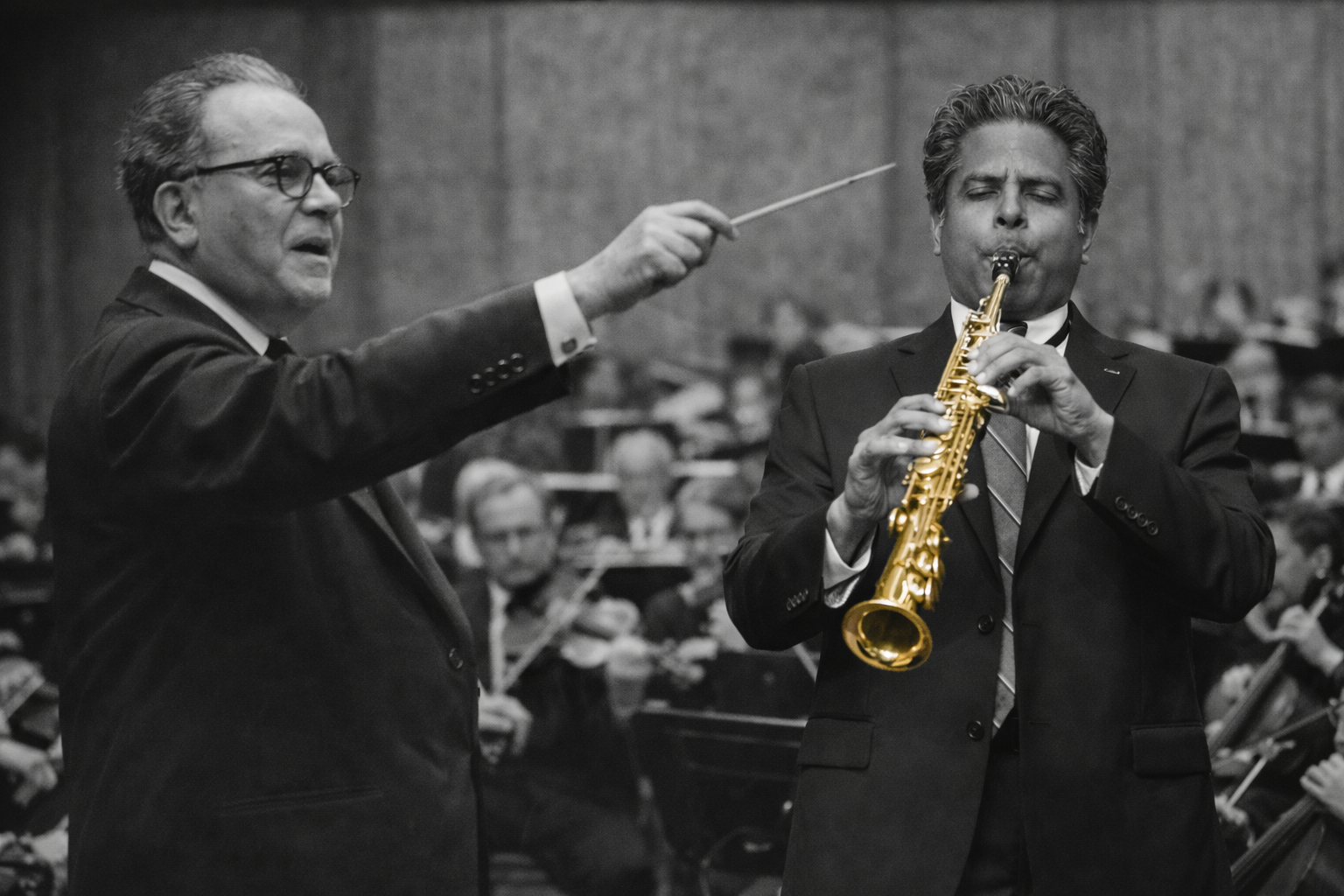
A Distinctive First Half for Soprano Saxophone and Orchestra
This program offers orchestras a fully realized, self-contained first half that explores the intersection of Brazilian modernism, mid-century orchestral color, and the emergence of a global musical language in the 1950s. Centered on Heitor Villa-Lobos’ rarely performed Fantasia for soprano saxophone, horns, and strings, and paired with Bachianas Brasileiras No. 5 in a newly adapted orchestral setting, the program positions the saxophone as a lyrical, expressive voice within the symphonic tradition.
Designed with flexibility in mind, this first half allows artistic leadership to shape the second half of the concert according to their audience, season arc, or institutional priorities—whether that means standard repertoire, contemporary works, or further exploration of jazz and Latin American influences.
about the Fantasia
Heitor Villa-Lobos composed the Fantasia for soprano saxophone, three horns, and strings in 1948, during a period of renewed creative focus in Brazil following his years abroad. The work was written for Marcel Mule, the legendary French saxophonist who was instrumental in establishing the saxophone within the classical tradition. Although Mule ultimately did not perform the piece, his influence is evident in Villa-Lobos’ highly idiomatic and lyrical writing for the instrument.
The Fantasia was premiered in 1951 in Rio de Janeiro, with Brazilian saxophonist Waldemar Szpilman as soloist, accompanied by orchestra under Villa-Lobos’ direction. The premiere helped establish the work as one of the most significant early contributions to the soprano saxophone’s concert repertoire, reflecting Villa-Lobos’ unique synthesis of Brazilian musical language and European form.
A Flexible Program Designed for Your Season
I offer a distinctive and flexible first half program built around Villa-Lobos’ Fantasia and Bachianas Brasileiras No. 5, highlighting the soprano saxophone in a richly lyrical and symphonic context. This program traces the evolution of a mid-century musical language shaped by Brazilian influence and its dialogue with American and European traditions.
The structure is intentionally designed to stand on its own while leaving space for you to curate a complementary second half that aligns with your artistic vision and audience strategy. Whether paired with core repertoire or thematic programming, this offering provides a compelling and accessible entry point for audiences while maintaining artistic depth.
Opening Work Options (Orchestra Only)
To complete the first half, I offer three ideas as opening work options that establish the sound world and create a natural arc into the Villa-Lobos works:
Option 1 — Samuel Barber: Adagio for Strings
A familiar and emotionally resonant work that immediately draws audiences in while establishing the warm, sustained string sound that flows naturally into the Villa-Lobos aesthetic.
Option 2 — Heitor Villa-Lobos: Bachianas Brasileiras No. 1 or No. 9
A cohesive, all–Villa-Lobos opening that foregrounds Brazilian musical language and creates a unified stylistic arc across the first half.
Option 3 — Aaron Copland: Quiet City
A transparent, lyrical work that reflects the introspective side of mid-century American music and subtly bridges classical and jazz-influenced sound worlds.
This modular first half can be programmed as part of a broader thematic concert or paired with standard repertoire, offering both artistic integrity and programming flexibility.