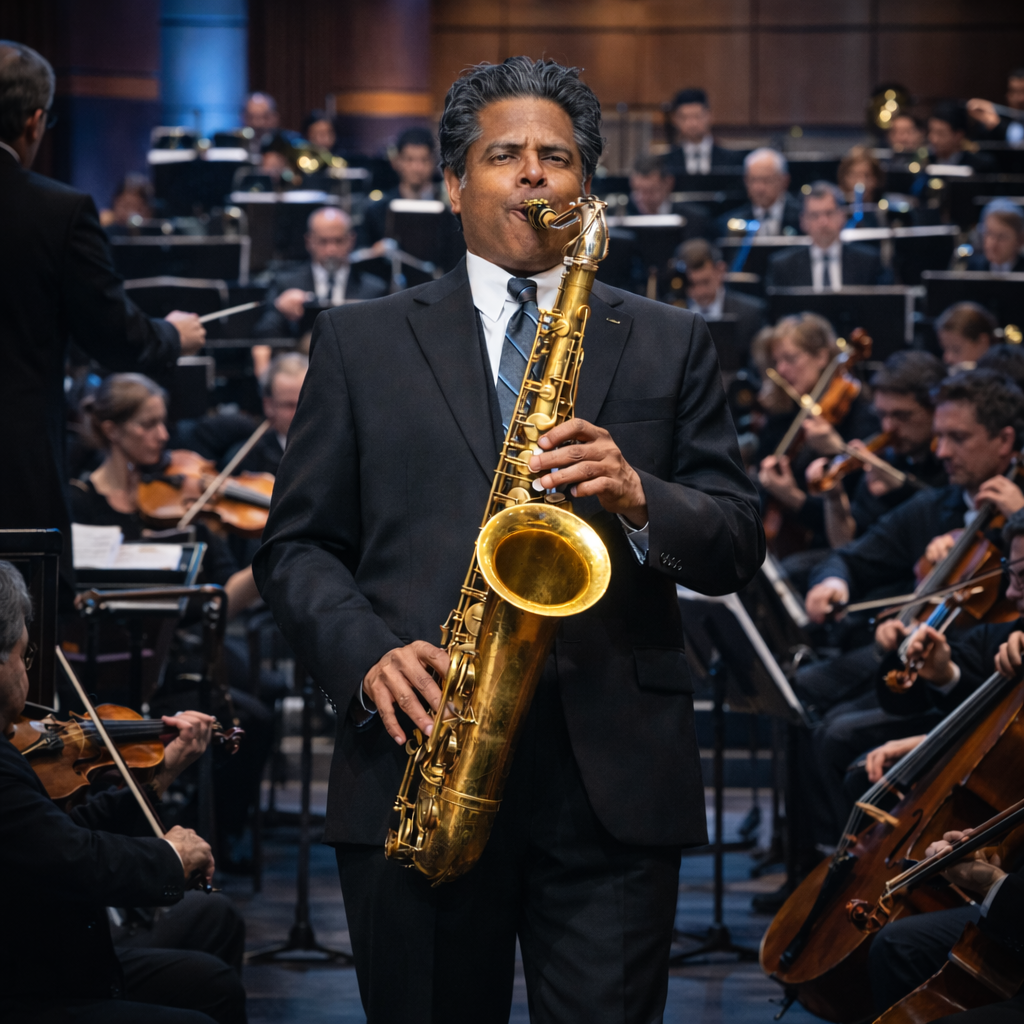
A symphonic tribute to the sound of the 1950s
Suggested 2nd Half Program Presentation
Richard Rodney Bennett, Concerto for Stan Getz, 24’
Anjan Shah, Velvet Horizon, 5’10”
Anjan Shah, Confluence, 1959, 4’32”
Encore - The Girl from Ipanema, 3’35”
TOTAL TIME: 37’17”
overview
For orchestras seeking programming that honors tradition while meaningfully broadening audience reach, this offering provides a rare opportunity. It connects the structural rigor of the concerto form with the emotional immediacy of mid century jazz, creating an entry point for jazz audiences without compromising symphonic integrity.
Stan Getz remains one of the most recognizable voices in American music. By presenting Richard Rodney Bennett’s Concerto for Stan Getz alongside complementary orchestral works rooted in the sound world of the 1950s, this program bridges subscriber familiarity, cross genre curiosity, and historical continuity.
It is not a pops presentation, nor a crossover novelty. It is a thoughtfully constructed half program that situates the tenor saxophone fully within the orchestral tradition while inviting new listeners into the hall.
Listen to the tunes below:
A Complete 2nd Half Program
This half program brings the unmistakable lyric voice of Stan Getz into the symphonic tradition with depth, elegance, and historical resonance.
At its center is Richard Rodney Bennett’s Concerto for Stan Getz, a work that does not dilute jazz for the orchestra, but instead places the tenor saxophone squarely within the concerto lineage. Bennett’s score captures the cool lyricism, harmonic sophistication, and emotional restraint that defined mid century jazz, while preserving the structural weight and dramatic arc audiences expect from a concerto experience.
Surrounding the Bennett are two original orchestral works written in dialogue with that same sound world, extending the aesthetic into a cohesive artistic statement.
Velvet Horizon
A soaring cantabile theme unfolds over gently syncopated string textures and subtle guitar color, gradually expanding into a richly layered orchestral tapestry. The work builds toward a luminous restatement before dissolving into a transparent, suspended coda.
Confluence, 1959
A study in rhythmic poise and harmonic ascent, this work merges American jazz harmony with Brazilian lyric sensibility within a fully symphonic framework. Rising sequences and evolving orchestration create momentum, elegance, and quiet propulsion.
The program concludes with the original orchestral arrangement of The Girl from Ipanema, the same version performed by Stan Getz with the Boston Pops under Arthur Fiedler in 1966. The result is not nostalgia, but continuity — a reminder that this conversation between jazz and orchestra has deep roots and enduring relevance.
Together, these works create a unified half program that is historically grounded, artistically rigorous, and immediately accessible — inviting core subscribers and new audiences into the same musical experience.
Overview of symphonic music in the 1950s
The 1950s were a period of remarkable cross-pollination in American music, when the boundaries between the concert hall, the jazz club, and the global soundscape became increasingly porous. Composers and performers were searching for a distinctly modern voice that could reflect the sophistication, urban energy, and cultural openness of the postwar era. Leonard Bernstein helped bring jazz language into symphonic and theatrical works, while William Grant Still had already demonstrated earlier in the century how blues, spirituals, and jazz harmony could live naturally within symphonic form. At the same time, composers associated with Gunther Schuller’s emerging “Third Stream” philosophy explored deeper integrations of jazz improvisational language and classical structure.
Parallel to these developments, a new influence began to emerge from Brazil. The gentle rhythmic sway and harmonic elegance that would soon be recognized as bossa nova began entering the American musical vocabulary through recordings, touring musicians, and cultural exchange between North and South American artists. Brazilian composers such as Antônio Carlos Jobim and performers like João Gilberto introduced a refined rhythmic language and lyrical restraint that resonated strongly with the cool jazz aesthetic already developing in the United States. American jazz musicians quickly embraced these sounds, and the resulting dialogue created a new transnational musical language built on sophisticated harmony, subtle rhythm, and melodic clarity.
What emerged from this era was not simply stylistic fusion but an expansion of the American musical imagination. Blues language, jazz harmony, Brazilian rhythmic sensibility, and classical orchestral color began to coexist in ways that felt both natural and innovative. For orchestras today, revisiting this moment offers a compelling framework for full length programming that is historically grounded, culturally rich, and unmistakably American in its spirit of artistic openness and collaboration.
Programming That Expands Your Reach
Let’s discuss how this program can support your artistic planning and audience development objectives. Please contact me through the website form or email me directly at anjanshah1966 (at) gmail.com to schedule a conversation.